
Certainly, you have heard of the big battles that occurred around July of 1863 in places like Vicksburg, Mississippi and Gettysburg, Pennsylvania. While fighting had just ended in both of these locations, it is important to realize how widespread fighting really was.
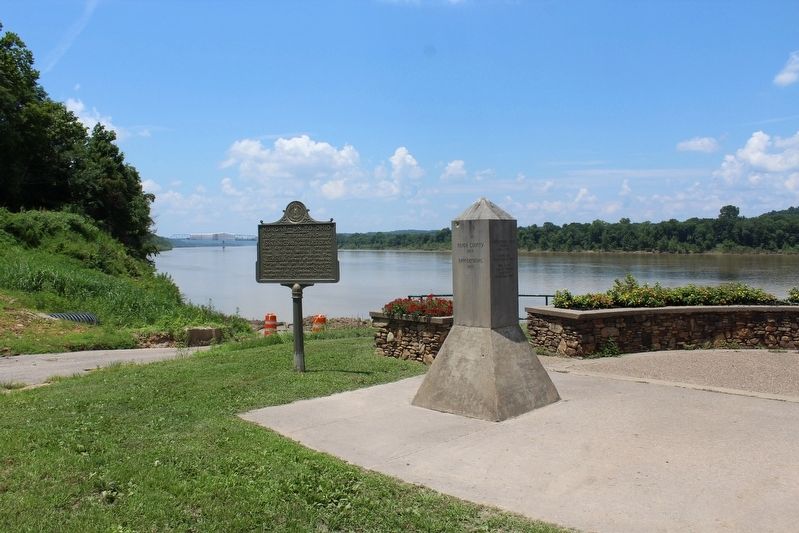
Brandenburg, Kentucky and Mauckport, Indiana are important locations in history beginning on July 8, 1863. Actually, this area was in the sights of the Confederacy much earlier than that.
How did we cross the large rivers such as the Mississippi, Tennessee, Missouri, and Ohio? That is a great question! There were no mega bridges like today, but there were all kinds of steamboat operations in many areas.
Alice Dean was a steam powered side wheeler. She was a fairly new vessel built in Cincinnati in 1863 and was designed as a passenger vessel on a route between Cincinnati and Memphis, Tennessee. She was 186′ in length with a beam of 42 feet. Her draft was approximately 7 1/2″. Some accounts place her at over 800 tons (which is fairly big) while other accounts list her as a smaller vessel in the mid 400 tons. Like anything in history, she might have lived out her career in relative obscurity except for the assistance of John Hunt Morgan and his 2,500 raiders.
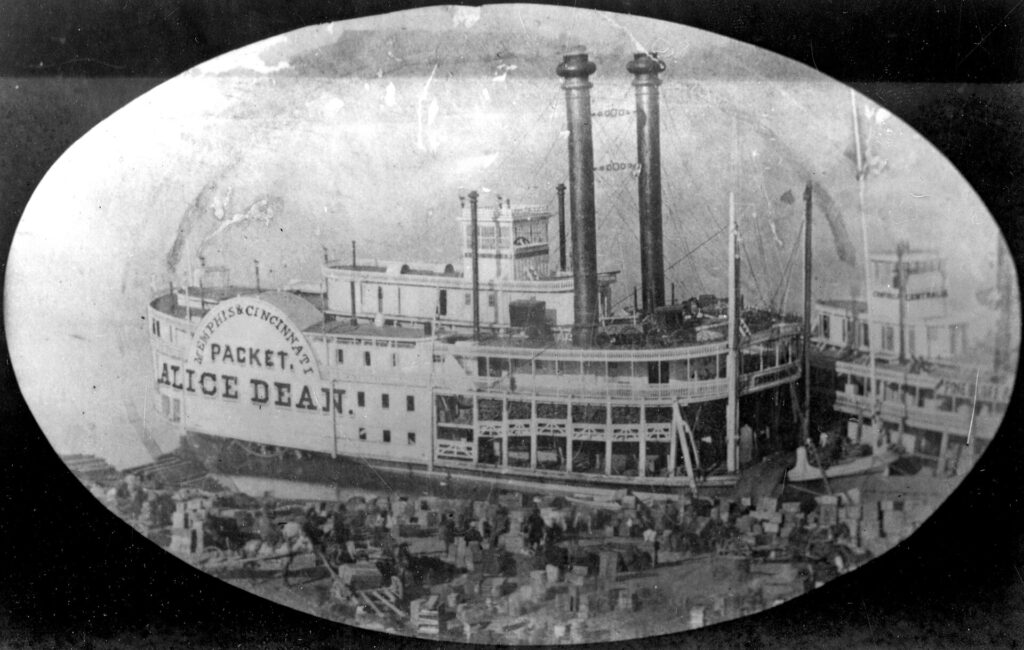
To compare sizes, the Belle of Louisville which is still in operational condition is a different type of boat. First, it is about 50 years newer than the Alice Dean. It has a draft of approximately 6 feet, a length of approximately 160 feet and a beam of 36 feet. It has a stern paddle wheel versus side wheels.
It all began on July 7-9 1863 near Brandenburg, Kentucky. Mauckport, Indiana is on the opposite river bank. At an earlier point, it is reported that General Morgan had “captured” the steamship John T. McCombs, a mail/package vessel. The master of the McCombs was friends with Morgan’s second in command and brother-in-law, Basil Duke. So, was it captured or borrowed? History might never get the real story.
The McCombs was used as a decoy to lure the Alice Dean into a position in which it could be captured. She was used to ferry the raiders from Brandeburg across the river to a spot near Mauckport, Indiana. Some reports indicate that the Indiana state militia, along with Union gunboats, tried to keep the cavalry from crossing but were driven back by Morgan’s artillery fire.
Once the Raiders were finished with the Alice Dean, she was burned and sunk to prevent any pursuing federal forces to have the same accessability and opportunity to continue the pursuit. Reports vary, but it is thought that machinery such as boilers and the engine were raised from the wreck and utilized on other ships not long after she was destroyed . The rest of the remains were left at the bottom of the Ohio River.
So, you think Indiana was 100% pro Union? Well, you haven’t been paying attention to the rest of the history on this site. The John T. McCombs was not destroyed, and as a courtesy, was allowed to return to Kentucky.
In 1965, a new river crossing was built between these two towns. They are located approximately 45 river miles below Louisville’s McAlpine Lock & Dam. The Matthew E Welsh Memorial Bridge (He served as governor from 1961-1965. He was best known for civil rights movements and significantly higher taxes. So high that many Hoosiers started to write sayings on their license plates like, “Indiana—Land of Taxes”. ) helped connect Kentucky to Indiana.
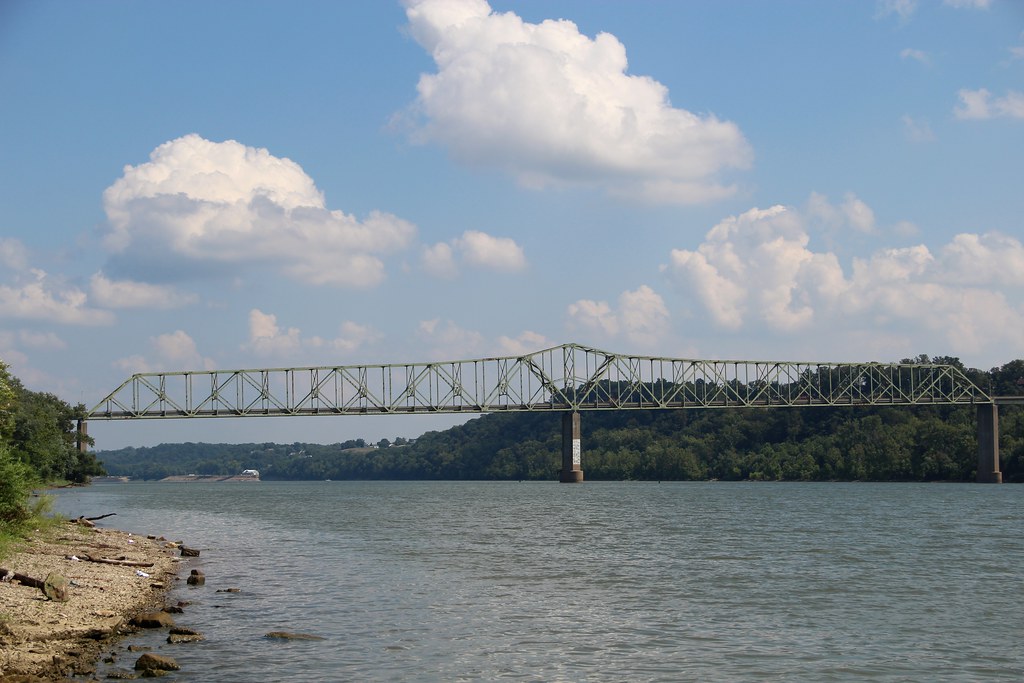
The bridge construction, for whatever reason, renewed interest in the remains of the Alice Dean which had rested on the bottom of the Ohio for 102 years at that point. An account by a sailor in the 1960s indicated that a clamshell type bucket was being used to pull up the “bones” of the Alice Dean and piling them high on a barge for removal. Before this, local souvenier hunters would reportedly pick over the wreck whenever the water level was low enough to expose the remains. If you know where parts and pieces can be found, please leave a comment.
But, let’s get back to the original topic of this blog. The important part of the bridge picture is understanding the logistical nightmare that Morgan and his men faced. It is reported that much of Morgan’s success stemmed from him being a sly and cunning individual and charismatic leader for his Kentuckians who rode with him.
We will talk more about Morgan’s Raid in a separate blog post. Some facts that will be discussed include:
Morgan was a guerilla fighter
It was worrisome to Lincoln and Grant that guerrilla fighting would continue even after Lee’s surrender.
Omitted from the official record is that Morgan did the entire raid WITHOUT ORDERS.
His commander, Braxton Bragg, had specifically forbidden Morgan from crossing the Ohio because he feared exactly what did happen, that Morgan and his entire command would be captured.

Very interesting read. Morgan was quiet the man.